


While the Trump administration’s policies drive up energy costs, California is protecting consumers
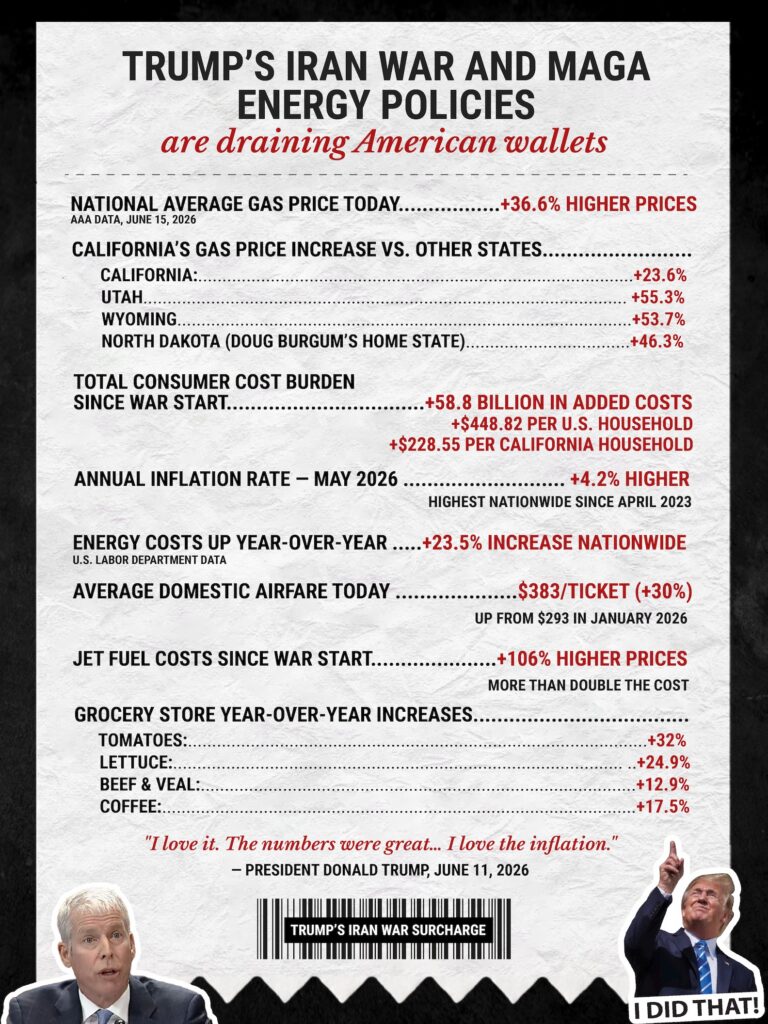
What you need to know: At 107 days, Trump’s reckless Iran war has cost Americans a growing $58.8 billion in extra fuel costs. California’s petroleum watchdog is out with a new market update — and the findings make clear that Trump’s recklessness is still hitting consumers hard.
SACRAMENTO — Last week, California’s Division of Petroleum Market Oversight (DPMO), the nation’s first and only independent petroleum watchdog, issued its latest California Gasoline and Diesel Market Update. The findings are clear: the Iran war has driven up gas prices across the country and branded gasoline suppliers in California are adding to the pain at the pump.
Over 3 months ago, Donald Trump launched a war with no plan to protect the Strait of Hormuz — trapping an estimated 20% of the global oil supply in the Persian Gulf. Every $10-per-barrel increase in crude translates to roughly 24 cents more per gallon, which has hit drivers in Texas, Florida, California, and everywhere else.
“Donald Trump launched a war with no plan to protect Americans’ economic security, and over 3 months later, every state is still paying the price. He’s eating into workers’ wages, wiping out their tax refunds, and driving up the cost of everything from gas to groceries to plane tickets. And his response is to say he loves inflation while Big Oil rakes in profits. American families shouldn’t have to pay the price for Trump’s negligence. That’s why California’s petroleum watchdog is monitoring the market every single day to protect consumers.”
Governor Gavin Newsom
California’s watchdog monitoring the market and protecting consumers
DPMO is an independent agency within the California Energy Commission and the only petroleum market watchdog of its kind in the United States. Between February 28 and June 12, 2026, retail gas prices rose by $1.14 per gallon in California — in line with the average state price increase of $1.19/gal, according to OPIS/AAA estimates. California’s price increase ranks 32nd among U.S. states and the District of Columbia. The state with the highest increase is Utah, at $1.53/gal.
California has the third-largest oil refining sector in the U.S. In recent weeks, product inventories on the West Coast have been consistent with — and sometimes healthier than — inventories in the rest of the country. The Iran conflict has created what the International Energy Agency called “the largest supply disruption in the history of the global oil market,” and the California Energy Commission continues to monitor supply conditions daily alongside DPMO and other state agencies.
Thanks to Senate Bill X1-2 — the California Gas Price Gouging and Transparency Law — California has critical forward visibility into supply conditions that most states simply do not have. Gas prices in California had been stable for roughly two years before the conflict began. That stability is a direct result of the oversight tools and market transparency laws championed by Governor Newsom and enacted by the Legislature.
Branded gasoline prices: adding unjustified pain on top of pain
DPMO’s market update identifies a persistent and growing gap between branded and unbranded gasoline prices in California. As of 2026, branded gasoline costs $0.31/gal more than unbranded in California. That’s compared to just $0.06/gal more in the rest of the country. Chevron and Shell are the highest-priced brands, with Chevron’s premium over local competitors growing from $0.19/gal in 2010 to more than $0.65/gal today.
Every gallon sold in California — branded or unbranded — must meet the same rigorous state standards for emissions control and engine performance. There is no public evidence that branded gasoline outperforms unbranded gasoline in California. DPMO’s investigative counsel are already on it, contacting approximately 20 of the highest-priced retail stations to determine whether prices are justified by actual input costs.
Experts say Americans will be paying for Trump’s war for years
Even if the Strait of Hormuz were to fully reopen today, experts agree that Americans will be paying Trump’s Iran war tax for months, if not years, to come. GasBuddy petroleum analyst Patrick De Haan told CBS News it will be “a very long, multi-month to multi-year process for things to fully normalize,” adding that pre-war fuel prices won’t return “until potentially mid-to-late 2027.” University of Houston energy economist Ed Hirs told Texas Public Radio that even if peace breaks out, “it would probably be eight months before we could see production and throughput from the strait restored and inventories restored, so that we could get back to a prewar equilibrium.” And Goldman Sachs says it expects higher energy prices to “erode” consumers’ spending power through the rest of 2026 — hitting lower-income households hardest, since they spend a larger share of their budgets on food and energy.
Trump started a war that destroyed critical oil infrastructure, and it cannot be switched back on overnight. IEA executive director, Fatih Birol, has warnedthat it could take as long as two years to repair facilities and restore oil and gas production to prewar levels. QatarEnergy has said it could take up to five years to repair the damage from Iranian missile strikes to its facilities.
Meanwhile, Goldman Sachs and Morgan Stanley have reached the same conclusion: the Iran war has almost entirely canceled out Americans’ tax refunds.

 WeEvolveIT